Tenant Isolation
Identify tenants and define tenant-aware policy, quotas, routing, residency, and dedicated-pool behavior.
Always confirm availability in the release bundle selected for deployment.
At a glance
| Property | Value |
|---|---|
| Pipeline phase | Router |
| Category | Routing |
| Canonical minimum tier | Business |
| Canonical entitlement | Yes |
| Supported deployment contract | Yes |
| Release status | Catalog component; confirm a bundle that executes router-phase components. |
Release accuracy
- Current documentation: Catalog component; confirm a bundle that executes router-phase components.
Where any detail below conflicts with the release status above, the release status is authoritative. Field names and examples describe the current dashboard and CRD surface; always confirm behavior against the selected release bundle before relying on it operationally.
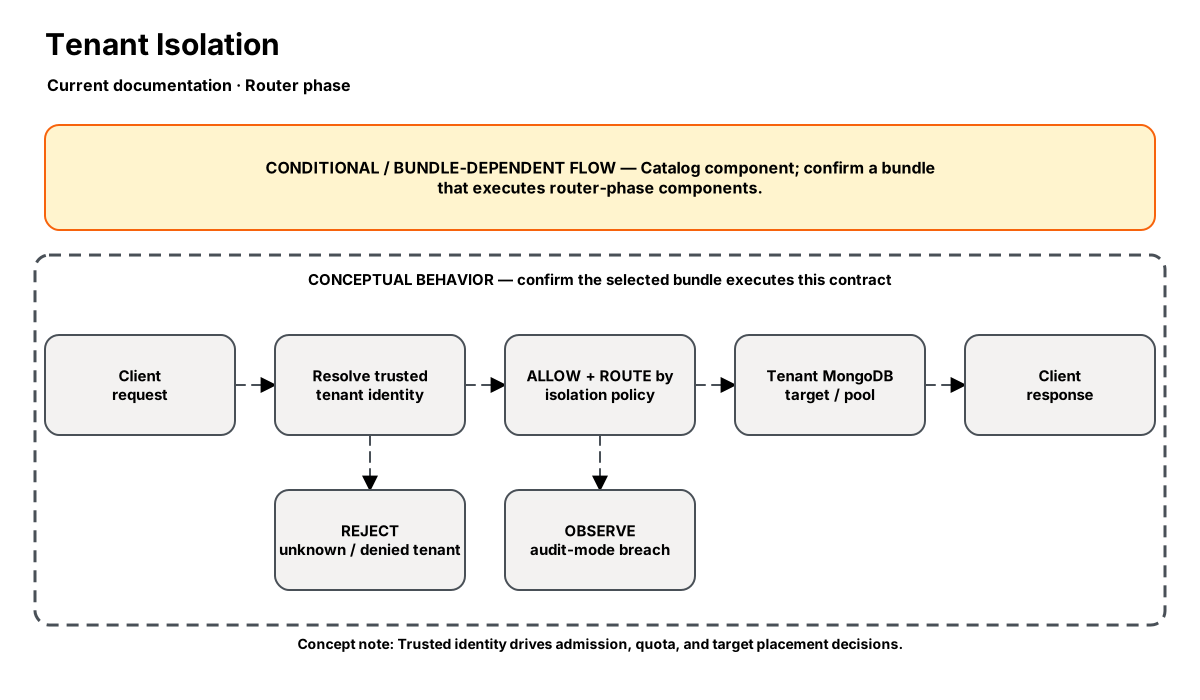
Release-aware feature flow. The diagram is explanatory; the release status on this page is authoritative.
Diagram resources: Open the SVG full screen · Download the editable Excalidraw source
Performance impact
:::warning Unverified performance figures
These figures are illustrative only. They are not current benchmarks or service guarantees and have not been verified by the current test suite.
:::
| Percentile | Reported figure |
|---|---|
| P50 | 0.10ms |
| P95 | 0.28ms |
| P99 | 0.55ms |
Note: Identity lookup and local policy evaluation are in-memory. Enterprise routing, residency checks, and quotas add modest overhead but remain sub-millisecond on typical configs.
Overview
The Tenant Isolation step establishes a hard tenant boundary before MongoDB ever sees the request. Nexo identifies the tenant, verifies that the request belongs to that tenant, enforces per-tenant quotas and policy lists, and can then route the request to a tenant-specific backend or region.
The feature is intentionally tiered:
- Free: field-path or header extraction, fail-closed handling for missing tenant context, and basic violation logging.
- Pro: JWT/connection-metadata extraction, audit-or-block cross-tenant detection, per-tenant quotas, allow/deny controls, and tenant-level audit evidence.
- Enterprise: premium routing rules, region-aware data residency, dedicated pools per tenant, real-time breach alerting, and the foundations needed for tenant chargeback and performance isolation.
Use it when you operate a shared MongoDB proxy tier for many customers and need stronger guarantees than application code alone can provide.
When to use
- Enforcing a single tenant context on every query before it reaches MongoDB
- Giving premium tenants dedicated backends, regions, or warm connection pools
- Protecting shared proxy capacity with per-tenant request and connection quotas
- Blocking or auditing cross-tenant access attempts for compliance programs
- Keeping tenant traffic inside approved regions for sovereignty or residency requirements
How it works
- Identification: the proxy extracts tenant identity from a field path, request header, JWT claim, or connection metadata.
- Admission control: unidentified requests are rejected, warned, or routed to a default backend based on policy. Allowlist/denylist checks run before forwarding.
- Isolation enforcement: Pro cross-tenant inspection can run in strict mode (hard block) or audit mode (log and continue). Per-tenant quotas throttle noisy tenants before they affect neighbors.
- Routing & placement: Enterprise rules map tenant ids or patterns to backend targets, regions, and dedicated pools so premium or regulated tenants can be isolated from the shared fleet.
- Breach handling: violations are logged, optionally emitted to an audit trail, and can trigger enterprise alerting hooks for real-time response.
Configuration
“Not specified” means required semantics were not declared for that field.
| Field | Type | Default | Required | Description |
|---|---|---|---|---|
identificationStrategy | select | header | Yes | How the tenant is identified: field, header, jwt, or connection |
fieldPath | string | tenantId | No | MongoDB field path used when identificationStrategy is field |
headerName | string | X-Tenant-ID | No | HTTP or proxy header used when identificationStrategy is header |
jwtClaimPath | string | claims.tenant_id | No | Dot-path into verified JWT/OIDC claims when identificationStrategy is jwt |
connectionMetadataKey | string | auth.user | No | Connection metadata key used when identificationStrategy is connection |
unidentifiedRequestBehavior | select | reject | No | What to do when tenant context is missing: reject, allow_warning, or route_default |
rejectUnidentified | bool | true | No | Boolean fail-closed switch for environments that always reject missing tenant context |
logViolations | bool | true | No | Emit isolation violations to logs / audit pipelines |
crossTenantBlocking | select | strict | No | Cross-tenant enforcement mode: strict, audit, or disabled |
perTenantRateLimit | object | {"requestsPerSecond":250,"maxConnections":100} | No | { requestsPerSecond, maxConnections } tenant quota object (Pro) |
allowlist | string[] | — | No | Explicit list of tenant ids or patterns allowed to execute through the proxy (Pro) |
denylist | string[] | — | No | Tenant ids or patterns denied immediately (Pro) |
tenantRouting | object[] | — | No | Array of { tenantId, target } mappings for enterprise tenant-aware routing |
defaultTarget | string | — | No | Fallback backend used when unidentifiedRequestBehavior is route_default |
dedicatedPools | object | {"enabled":false,"poolSize":25} | No | { enabled, poolSize } to reserve warm connections per tenant (Enterprise) |
dataResidency | object[] | — | No | Array of { tenantPattern, allowedRegions[] } rules for residency enforcement (Enterprise) |
breachAlerting | object | — | No | { enabled, webhookUrl } real-time isolation alerting configuration (Enterprise) |
Settings reference
No additional settings reference is documented for this component.
Examples
Free tier: header-based fail-closed isolation
router:
  name: builtin:tenant-isolation
  config:
    identificationStrategy: header
    headerName: X-Tenant-ID
    unidentifiedRequestBehavior: reject
    rejectUnidentified: true
    logViolations: true
Pro tier: JWT-based isolation with quotas and audit-only cross-tenant detection
router:
  name: builtin:tenant-isolation
  config:
    identificationStrategy: jwt
    jwtClaimPath: claims.tenant_id
    crossTenantBlocking: audit
    perTenantRateLimit:
      requestsPerSecond: 500
      maxConnections: 150
    allowlist: [acme, globex, premium-*]
    denylist: [suspended-*]
    logViolations: true
Enterprise tier: premium routing, residency, dedicated pools, and alerts
router:
  name: builtin:tenant-isolation
  config:
    identificationStrategy: connection
    connectionMetadataKey: auth.user
    unidentifiedRequestBehavior: route_default
    defaultTarget: shared-mongo.internal:27017
    tenantRouting:
      - tenantId: acme-enterprise
        target: mongo-acme-us.internal:27017
      - tenantId: globex-eu
        target: mongo-globex-eu.internal:27017
    dedicatedPools:
      enabled: true
      poolSize: 40
    dataResidency:
      - tenantPattern: globex-*
        allowedRegions: [westeurope, northeurope]
    breachAlerting:
      enabled: true
      webhookUrl: https://hooks.example.net/tenant-isolation
Best practices
- Fail closed (
unidentifiedRequestBehavior: reject) unless you have a well-defined shared fallback backend. - Prefer header or JWT extraction for deterministic identity; use field-path extraction only when tenant identity truly lives inside the query payload.
- Use audit mode first for cross-tenant detection to learn your workload, then switch to strict mode once false positives are understood.
- Pair dedicated pools with per-tenant quotas so premium isolation does not become an unbounded cost center.
- Treat denylist, residency, and breach alerting rules as part of your compliance change-management process.
Limitations
- Field-path extraction depends on tenant identity being present in the query payload; malformed or encrypted payloads reduce visibility.
- Rate limits are evaluated per proxy instance unless backed by a shared limiter implementation.
- Residency enforcement validates configured targets/regions — it does not automatically move tenant data between regions.
- Enterprise analytics and chargeback require downstream metric collection even though this step emits the right tenant context.
Security and operational guidance
- Use authenticated, non-spoofable identity
- Fail closed when tenant identity is required
- The pinned Proxy controller does not watch NexoTenantIsolation directly
- Do not claim 0.2.0 data-path isolation
Related steps
Release availability
- Current documentation: Catalog component; confirm a bundle that executes router-phase components.
See the component catalog for the complete comparison matrix.