Read/Write Splitter
Route selected reads to secondary targets and writes to the primary.
Always confirm availability in the release bundle selected for deployment.
At a glance
| Property | Value |
|---|---|
| Pipeline phase | Router |
| Category | Routing |
| Canonical minimum tier | Pro |
| Canonical entitlement | Yes |
| Supported deployment contract | Yes |
| Release status | Catalog component; confirm a bundle that executes router-phase components. |
Release accuracy
- Current documentation: Catalog component; confirm a bundle that executes router-phase components.
Where any detail below conflicts with the release status above, the release status is authoritative. Field names and examples describe the current dashboard and CRD surface; always confirm behavior against the selected release bundle before relying on it operationally.
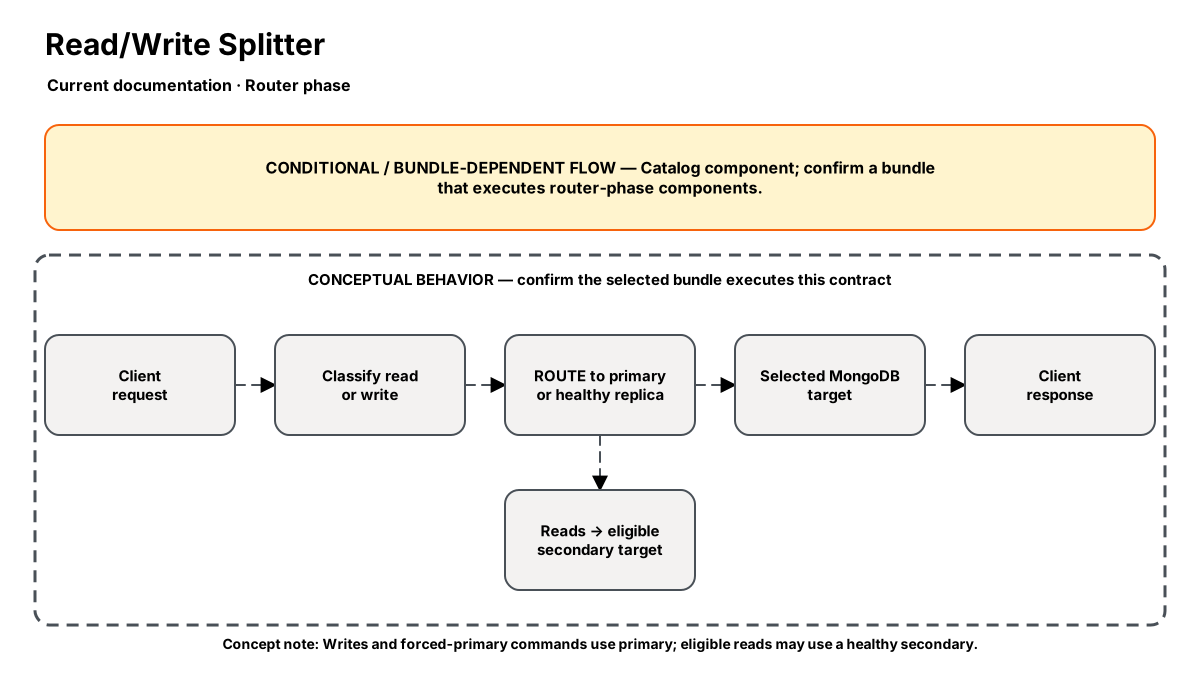
Release-aware feature flow. The diagram is explanatory; the release status on this page is authoritative.
Diagram resources: Open the SVG full screen · Download the editable Excalidraw source
Performance impact
:::warning Unverified performance figures
These figures are illustrative only. They are not current benchmarks or service guarantees and have not been verified by the current test suite.
:::
| Percentile | Reported figure |
|---|---|
| P50 | <0.1ms |
| P95 | <0.2ms |
| P99 | <0.3ms |
Note: Command classification is a simple map lookup
Overview
The Read/Write Splitter inspects each incoming MongoDB command and routes it to the appropriate target: writes always go to the primary, while reads are distributed across secondaries using your chosen strategy.
This is transparent to the application — no readPreference configuration needed in drivers. The splitter monitors replication lag and automatically routes reads back to primary if a secondary falls too far behind.
When to use
- Offloading read traffic from primary without changing application code
- Scaling read-heavy workloads across replica set members
- Reducing latency for read operations by using geographically closer secondaries
- Gradually rolling out secondary reads with staleness guarantees
How it works
- Incoming command is classified as read or write based on command name
- Writes always route to primary_target
- Reads are distributed to secondary_targets using the chosen strategy
- Replication lag is monitored — if a secondary exceeds max_staleness, it's removed from rotation
- Commands matching force_primary_patterns always go to primary regardless
Configuration
“Not specified” means required semantics were not declared for that field.
| Field | Type | Default | Required | Description |
|---|---|---|---|---|
primary_target | string | — | Yes | Primary MongoDB address |
secondary_targets | json | — | Not specified | List of secondary addresses |
strategy | select | round_robin | Not specified | Load balancing strategy for reads |
max_staleness | duration | 10s | Not specified | Max acceptable replication lag |
read_commands | json | [find, aggregate, count, distinct] | Not specified | Commands routed to secondaries |
force_primary_patterns | json | — | Not specified | Collections that always use primary |
Settings reference
No additional settings reference is documented for this component.
Examples
Basic read scaling
steps:
  - id: builtin:read-write-split
    config:
      primary_target: mongo-primary:27017
      secondary_targets:
        - mongo-secondary-1:27017
        - mongo-secondary-2:27017
      strategy: round_robin
      max_staleness: 5s
Latency-based with exclusions
steps:
  - id: builtin:read-write-split
    config:
      primary_target: mongo-primary:27017
      secondary_targets:
        - mongo-secondary-us:27017
        - mongo-secondary-eu:27017
      strategy: latency
      max_staleness: 30s
      force_primary_patterns:
        - "^billing_"
        - "^transactions"
Best practices
- Start with a conservative max_staleness (5-10s) and increase based on your consistency requirements
- Use force_primary_patterns for collections that require read-after-write consistency
- Monitor secondary lag with the metrics step to tune staleness thresholds
- latency strategy works best with geographically distributed secondaries
Limitations
- Aggregation pipelines with $out or $merge always route to primary
- Cannot split reads within a multi-document transaction
- Staleness detection requires periodic isMaster checks (every 5s by default)
Security and operational guidance
- Validate replication lag and causal consistency
- Keep transactions and primary-required operations on the primary
- Do not infer runtime support from schema presence
Related steps
Release availability
- Current documentation: Catalog component; confirm a bundle that executes router-phase components.
See the component catalog for the complete comparison matrix.