Geo-Routing
Status: Unsupported concept: dashboard manifest only. No canonical entitlement and no supported deployment contract.
:::danger Unsupported legacy concept
This describes a concept that Nexo does not currently implement. It has no canonical entitlement and no supported deployment contract. Do not infer a CRD, Operator reconciliation path, runtime implementation, or support commitment from the configuration and examples below.
:::
Always confirm availability in the release bundle selected for deployment.
At a glance
| Property | Value |
|---|---|
| Pipeline phase | Router |
| Category | Compliance |
| Canonical minimum tier | No canonical entitlement |
| Canonical entitlement | No |
| Supported deployment contract | No |
| Release status | Unsupported concept: dashboard manifest only. No canonical entitlement and no supported deployment contract. |
Release accuracy
- Current documentation: Unsupported concept: dashboard manifest only. No canonical entitlement and no supported deployment contract.
Where any detail below conflicts with the release status above, the release status is authoritative. Field names and examples describe the current dashboard and CRD surface; always confirm behavior against the selected release bundle before relying on it operationally.
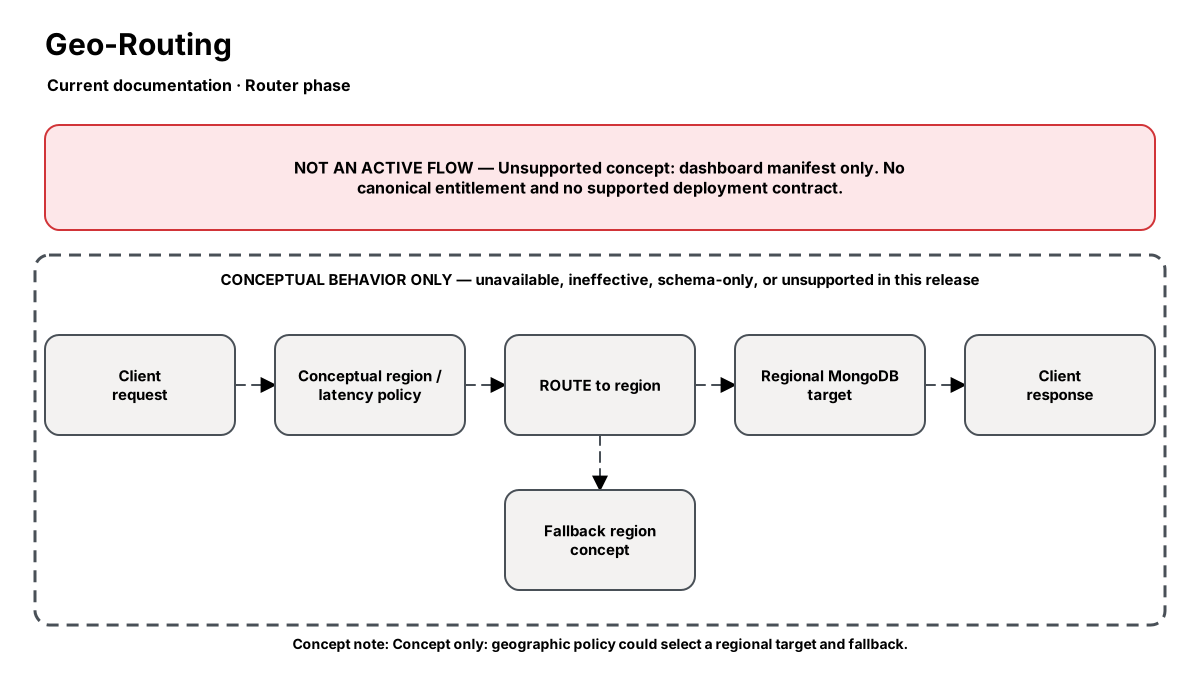
Release-aware feature flow. The diagram is explanatory; the release status on this page is authoritative.
Diagram resources: Open the SVG full screen · Download the editable Excalidraw source
Performance impact
:::warning Unverified performance figures
These figures are illustrative only. They are not current benchmarks or service guarantees and have not been verified by the current test suite.
:::
| Percentile | Reported figure |
|---|---|
| P50 | <0.1ms |
| P95 | <0.3ms |
| P99 | <0.5ms |
Note: Routing decision is a simple map lookup
Overview
The Geo-Routing step ensures data residency compliance by routing queries to the correct regional MongoDB cluster based on configurable detection rules. EU user data stays in EU clusters, US data in US clusters — enforced at the infrastructure level.
Cross-region queries can be blocked entirely, ensuring that no application bug can accidentally access data in the wrong jurisdiction.
When to use
- GDPR compliance — EU citizen data must stay in EU region
- Data sovereignty laws (China, Russia, Brazil, India)
- Multi-region deployments with strict data locality requirements
- Regulatory audits requiring proof of data residency enforcement
How it works
- Incoming query's region is determined (database name, IP geolookup, header, or user metadata)
- Region is mapped to a target cluster from the configuration
- Query is routed to the appropriate regional cluster
- If block_cross_region is enabled, queries to wrong region are rejected
- Routing decisions are logged for compliance audit
Configuration
“Not specified” means required semantics were not declared for that field.
| Field | Type | Default | Required | Description |
|---|---|---|---|---|
regions | json | — | Not specified | Region-to-cluster mapping: {region, target, databases} |
detection_method | select | database | Not specified | How to determine request region |
header_name | string | — | Not specified | Region header name (for header method) |
default_region | string | US | Not specified | Fallback region |
block_cross_region | boolean | true | Not specified | Block queries to wrong region |
log_violations | boolean | true | Not specified | Log routing violations |
Settings reference
No additional settings reference is documented for this component.
Examples
GDPR EU/US split
steps:
  - id: builtin:geo-routing
    config:
      detection_method: database
      block_cross_region: true
      log_violations: true
      regions:
        - region: EU
          target: mongo-eu-west-1:27017
          databases: [users_eu, orders_eu, analytics_eu]
        - region: US
          target: mongo-us-east-1:27017
          databases: [users_us, orders_us, analytics_us]
Best practices
- Use database naming conventions (suffix _eu, _us) for simplest detection
- Enable block_cross_region in production — log-only mode for testing
- Combine with audit step for compliance evidence
- Test with shadow traffic step before enforcing in production
Limitations
- GeoIP detection requires MaxMind database (not included, bring your own)
- Cross-region aggregations ($lookup across regions) are not supported
- header detection requires application cooperation to set the header
Security and operational guidance
- This is a legacy dashboard concept, not a canonically entitled Nexo component.
- No supported deployment contract, CRD mapping, Operator reconciliation path, or runtime execution guarantee is published.
- Treat every configuration example and performance number below as historical design material only.
Related steps
Release availability
- Current documentation: Unsupported concept: dashboard manifest only. No canonical entitlement and no supported deployment contract.
See the component catalog for the complete comparison matrix.