Shadow Traffic
Mirror sampled requests to a secondary target without using the shadow response for the client result.
This page belongs to the immutable 0.2.0 Private Preview documentation.
At a glance
| Property | Value |
|---|---|
| Pipeline phase | Request + response |
| Category | Traffic |
| Canonical minimum tier | Pro |
| Legacy dashboard tier label | Pro |
| Legacy rendered name | Shadow Traffic |
| Legacy rendered summary | Async request mirroring with optional response diffing, latency metrics, and business-grade targeting safeguards. |
| Canonical entitlement | Yes |
| Supported deployment contract | Yes |
| Release status | Reconciled and executable. |
Release accuracy
- 0.2.0 Private Preview: Reconciled and executable.
The detailed material below preserves every section rendered by the legacy dashboard. Where it conflicts with the release status above, the release status is authoritative. Legacy field names and examples are not a substitute for the selected bundle's CRD and runtime contract. Unsafe legacy wording is retained in metadata for traceability but is corrected in the rendered guidance.
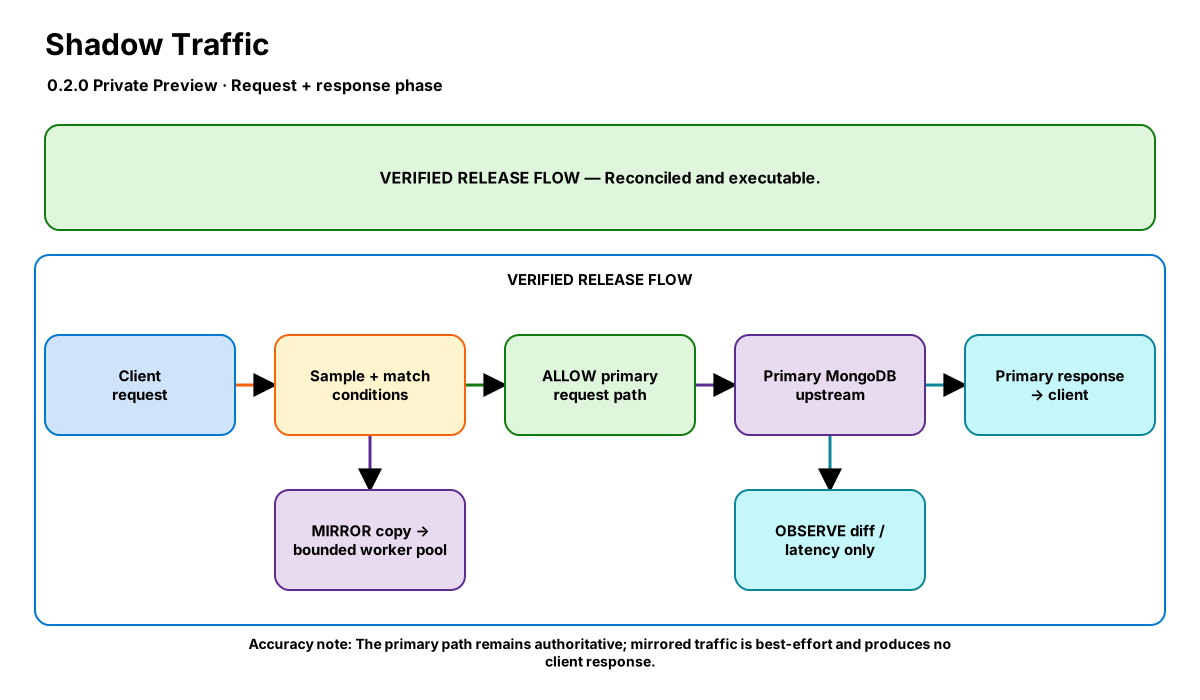
Release-aware feature flow. The diagram is explanatory; the release status on this page is authoritative.
Diagram resources: Open the SVG full screen · Download the editable Excalidraw source
Performance impact
:::warning Legacy, unverified performance claims
These numbers are preserved for documentation parity with the legacy dashboard. They are not current benchmarks or service guarantees and have not been verified by the current test suite.
:::
| Percentile | Legacy claim |
|---|---|
| P50 | 0.50ms |
| P95 | 1.20ms |
| P99 | 2.50ms |
Legacy note: Mirroring is asynchronous. Diff comparison and metrics run off the client path, while health checks add only in-memory bookkeeping.
Overview
The Shadow Traffic step mirrors live requests to one or more shadow backends without affecting the primary response path. It supports request sampling, bounded concurrency, connection pooling, optional primary-vs-shadow response hashing, per-target latency tracking, conditional shadow filters, and health-based auto-disable protection.
Use it when validating migrations, comparing cluster behavior, or measuring how alternate backends behave under real workloads.
When to use
- Validating a new MongoDB cluster or proxy configuration with production-like traffic
- Comparing deterministic query responses between primary and shadow backends
- Collecting latency baselines for candidate backends before a cutover
- Restricting shadowing to specific commands, databases, or collections during phased rollouts
How it works
- Request phase: the step checks sampling, optional database/collection/command conditions, and the health state of each shadow target.
- Dispatch: matching requests are copied (independent buffer) and submitted to a bounded worker pool (default: 128 workers, 256 queue depth). If the pool is saturated, shadow requests are silently dropped — the primary path is never blocked or slowed.
- Response capture (optional): when diff_comparison.enabled is true, the primary response hash is stored in StepContext during the response phase so request-side shadow workers can compare results.
- Metrics (optional): when latency_metrics.enabled is true, each target records request count, average latency, and a rolling P99 latency. Dropped tasks are also counted via
nexo_shadow_dropped_total. - Health monitor (optional): Business tier health tracking computes recent error rate per target and temporarily skips unhealthy shadow targets until the monitoring window expires.
- Backpressure: when shadow targets are slow or unresponsive, the bounded pool prevents goroutine accumulation and memory exhaustion. Shadow is always best-effort — degraded shadow targets never impact primary request latency or availability.
Configuration
The table preserves the legacy dashboard field reference. “Not specified” means the legacy source did not declare required semantics.
| Field | Legacy UI type | Legacy default | Required | Description |
|---|---|---|---|---|
targets | object[] | — | Yes | [{ name, address, tls? }] shadow destinations that receive mirrored traffic |
sample_rate | number | 1.0 | No | Fraction of requests to mirror from 0.0 to 1.0 |
max_concurrent | number | 100 | No | Maximum number of in-flight shadow requests across all targets |
timeout_ms | number | 5000 | No | Dial/read/write timeout for shadow target operations |
diff_comparison | object | — | No | { enabled: bool, log_diffs: bool } (Pro) |
latency_metrics | object | — | No | { enabled: bool } (Pro) |
conditions | object | — | No | { databases?: string[], collections?: string[], commands?: string[] } (Business) |
health_monitor | object | — | No | { enabled: bool, error_threshold_pct: number, window_sec: number } (Business) |
Settings reference
The legacy page did not render an additional anchored settings reference.
Examples
Pro response diffing against a validation cluster
request_steps:
  - name: builtin:shadow
    config:
      targets:
        - name: validation
          address: mongo-validation.internal:27017
      sample_rate: 1.0
      max_concurrent: 200
      diff_comparison:
        enabled: true
        log_diffs: true
      latency_metrics:
        enabled: true
response_steps:
  - name: builtin:shadow
    config:
      targets:
        - name: validation
          address: mongo-validation.internal:27017
      diff_comparison:
        enabled: true
        log_diffs: true
Business conditional shadowing with health protection
request_steps:
  - name: builtin:shadow
    config:
      targets:
        - name: eu-shadow
          address: mongo-shadow-eu.internal:27017
      sample_rate: 0.25
      conditions:
        databases: [app]
        collections: [tenant_users, tenant_orders]
        commands: [find, aggregate]
      health_monitor:
        enabled: true
        error_threshold_pct: 25
        window_sec: 120
Best practices
- Add the step to both request_steps and response_steps when using diff_comparison so the primary response hash is captured.
- Start with a low sample_rate when shadowing a backend with smaller capacity.
- Use conditions to limit shadow traffic to deterministic reads when comparing responses.
- Watch ShadowMetrics output for rising latency or disabled targets before increasing traffic.
- Monitor nexo_shadow_dropped_total — if drops increase, the shadow target may need capacity or sample_rate reduction.
Limitations
- Shadow requests still execute writes on the shadow backend unless filtered out by conditions.
- Response diffing compares hashes, not semantic BSON differences.
- Health-based disablement is temporary and scoped to the configured monitoring window.
- When the worker pool queue is full, shadow requests are dropped (best-effort, never blocks primary).
Security and operational guidance
- Do not mirror sensitive or production traffic in 0.2.0: the runtime uses plaintext TCP and does not honor the shadow TLS field
- Use only synthetic or otherwise non-sensitive test data
- Bound concurrency and timeouts so shadow failure cannot exhaust the Proxy
Related steps
Release availability
- 0.2.0 Private Preview: Reconciled and executable.
See the component catalog for the complete comparison matrix.