Read/Write Splitter
Status: Unavailable: NexoReadWriteSplit is schema-only and the pinned Proxy does not execute the router phase.
:::caution No supported deployment contract
This capability is documented for catalog completeness, but the selected release does not publish a supported end-to-end deployment contract.
:::
This page belongs to the immutable 0.2.0 Private Preview documentation.
At a glance
| Property | Value |
|---|---|
| Pipeline phase | Router |
| Category | Routing |
| Canonical minimum tier | Pro |
| Legacy dashboard tier label | Pro |
| Legacy rendered name | Read/Write Splitter |
| Legacy rendered summary | Automatically route reads to secondaries without any driver-level changes. |
| Canonical entitlement | Yes |
| Supported deployment contract | No |
| Release status | Unavailable: NexoReadWriteSplit is schema-only and the pinned Proxy does not execute the router phase. |
Release accuracy
- 0.2.0 Private Preview: Unavailable: NexoReadWriteSplit is schema-only and the pinned Proxy does not execute the router phase.
The detailed material below preserves every section rendered by the legacy dashboard. Where it conflicts with the release status above, the release status is authoritative. Legacy field names and examples are not a substitute for the selected bundle's CRD and runtime contract. Unsafe legacy wording is retained in metadata for traceability but is corrected in the rendered guidance.
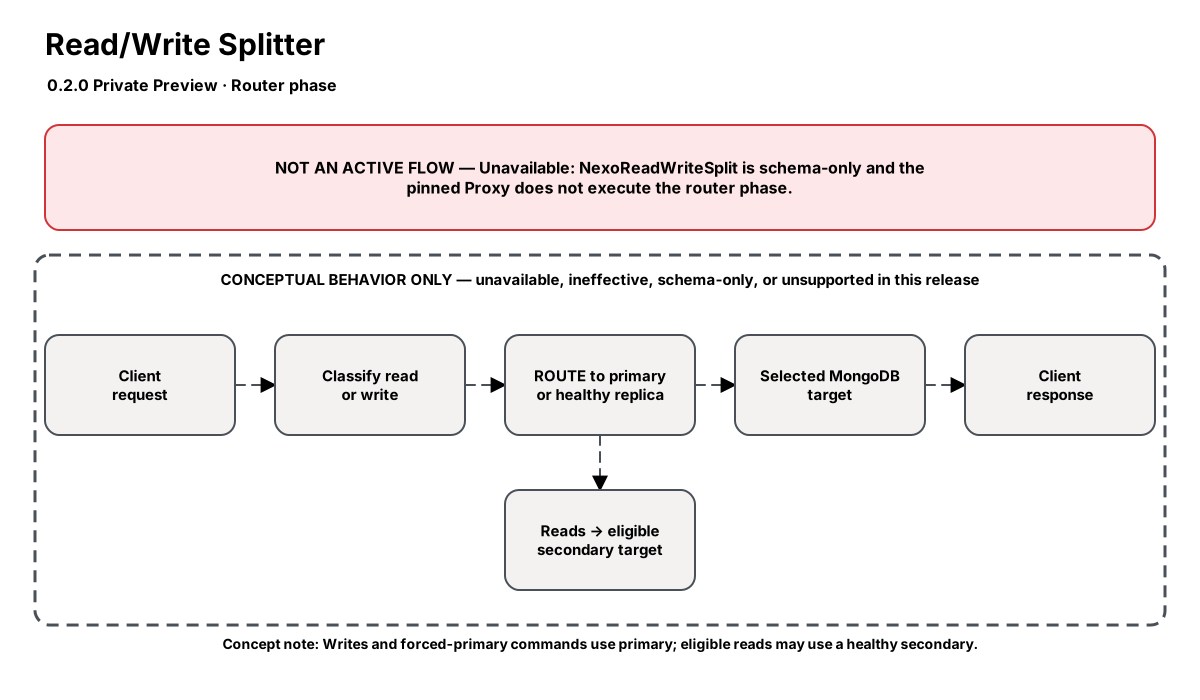
Release-aware feature flow. The diagram is explanatory; the release status on this page is authoritative.
Diagram resources: Open the SVG full screen · Download the editable Excalidraw source
Performance impact
:::warning Legacy, unverified performance claims
These numbers are preserved for documentation parity with the legacy dashboard. They are not current benchmarks or service guarantees and have not been verified by the current test suite.
:::
| Percentile | Legacy claim |
|---|---|
| P50 | <0.1ms |
| P95 | <0.2ms |
| P99 | <0.3ms |
Legacy note: Command classification is a simple map lookup
Overview
The Read/Write Splitter inspects each incoming MongoDB command and routes it to the appropriate target: writes always go to the primary, while reads are distributed across secondaries using your chosen strategy.
This is transparent to the application — no readPreference configuration needed in drivers. The splitter monitors replication lag and automatically routes reads back to primary if a secondary falls too far behind.
When to use
- Offloading read traffic from primary without changing application code
- Scaling read-heavy workloads across replica set members
- Reducing latency for read operations by using geographically closer secondaries
- Gradually rolling out secondary reads with staleness guarantees
How it works
- Incoming command is classified as read or write based on command name
- Writes always route to primary_target
- Reads are distributed to secondary_targets using the chosen strategy
- Replication lag is monitored — if a secondary exceeds max_staleness, it's removed from rotation
- Commands matching force_primary_patterns always go to primary regardless
Configuration
The table preserves the legacy dashboard field reference. “Not specified” means the legacy source did not declare required semantics.
| Field | Legacy UI type | Legacy default | Required | Description |
|---|---|---|---|---|
primary_target | string | — | Yes | Primary MongoDB address |
secondary_targets | json | — | Not specified | List of secondary addresses |
strategy | select | round_robin | Not specified | Load balancing strategy for reads |
max_staleness | duration | 10s | Not specified | Max acceptable replication lag |
read_commands | json | [find, aggregate, count, distinct] | Not specified | Commands routed to secondaries |
force_primary_patterns | json | — | Not specified | Collections that always use primary |
Settings reference
The legacy page did not render an additional anchored settings reference.
Examples
Basic read scaling
steps:
  - id: builtin:read-write-split
    config:
      primary_target: mongo-primary:27017
      secondary_targets:
        - mongo-secondary-1:27017
        - mongo-secondary-2:27017
      strategy: round_robin
      max_staleness: 5s
Latency-based with exclusions
steps:
  - id: builtin:read-write-split
    config:
      primary_target: mongo-primary:27017
      secondary_targets:
        - mongo-secondary-us:27017
        - mongo-secondary-eu:27017
      strategy: latency
      max_staleness: 30s
      force_primary_patterns:
        - "^billing_"
        - "^transactions"
Best practices
- Start with a conservative max_staleness (5-10s) and increase based on your consistency requirements
- Use force_primary_patterns for collections that require read-after-write consistency
- Monitor secondary lag with the metrics step to tune staleness thresholds
- latency strategy works best with geographically distributed secondaries
Limitations
- Aggregation pipelines with $out or $merge always route to primary
- Cannot split reads within a multi-document transaction
- Staleness detection requires periodic isMaster checks (every 5s by default)
Security and operational guidance
- Validate replication lag and causal consistency
- Keep transactions and primary-required operations on the primary
- Do not infer runtime support from schema presence
Related steps
Release availability
- 0.2.0 Private Preview: Unavailable: NexoReadWriteSplit is schema-only and the pinned Proxy does not execute the router phase.
See the component catalog for the complete comparison matrix.