Rate Limiting
Apply token-bucket request budgets by client, connection, tenant, or database.
This page belongs to the immutable 0.2.0 Private Preview documentation.
At a glance
| Property | Value |
|---|---|
| Pipeline phase | Request |
| Category | Security |
| Canonical minimum tier | Pro |
| Legacy dashboard tier label | Business |
| Legacy rendered name | Rate Limiting |
| Legacy rendered summary | Per-client and per-tenant rate limiting to prevent noisy neighbors. |
| Canonical entitlement | Yes |
| Supported deployment contract | Yes |
| Release status | Reconciled and executable. |
Release accuracy
- 0.2.0 Private Preview: Reconciled and executable.
The detailed material below preserves every section rendered by the legacy dashboard. Where it conflicts with the release status above, the release status is authoritative. Legacy field names and examples are not a substitute for the selected bundle's CRD and runtime contract. Unsafe legacy wording is retained in metadata for traceability but is corrected in the rendered guidance.
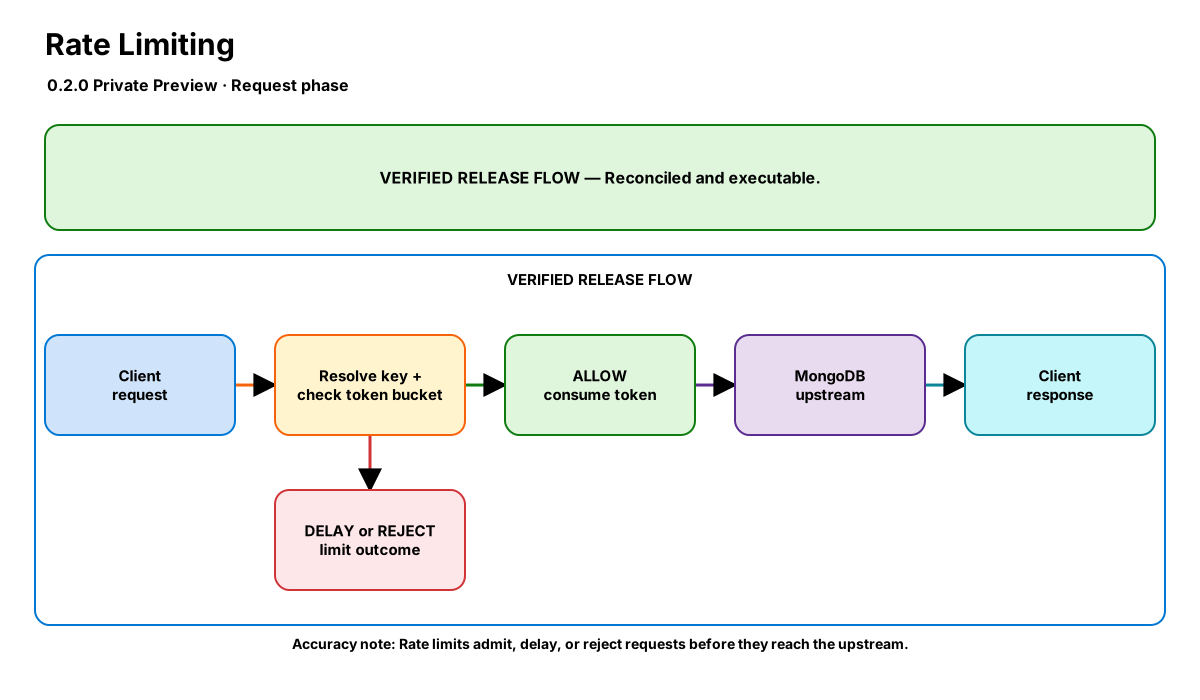
Release-aware feature flow. The diagram is explanatory; the release status on this page is authoritative.
Diagram resources: Open the SVG full screen · Download the editable Excalidraw source
Performance impact
:::warning Legacy, unverified performance claims
These numbers are preserved for documentation parity with the legacy dashboard. They are not current benchmarks or service guarantees and have not been verified by the current test suite.
:::
| Percentile | Legacy claim |
|---|---|
| P50 | 0.05ms |
| P95 | 0.12ms |
| P99 | 0.20ms |
Legacy note: In-memory token bucket. O(1) check and decrement.
Overview
The Rate Limiting step enforces request quotas at the proxy layer using a token bucket algorithm. Limits can be applied per client IP, per authenticated user, per tenant, or globally.
This protects shared MongoDB clusters from individual clients or tenants consuming disproportionate resources — the "noisy neighbor" problem in multi-tenant architectures.
When to use
- Multi-tenant environments where one tenant could overwhelm shared resources
- Protecting MongoDB from accidental request storms (retry loops, batch jobs)
- Enforcing SLA-based quotas per customer tier
- Gradual rollout — limit new clients until their access patterns are validated
How it works
- Request phase: Extracts the rate limit key (client IP, user, tenant ID).
- Checks the token bucket for that key — if tokens available, deduct one and pass through.
- If no tokens: return a synthetic error (or delay) based on configured action.
- Buckets are refilled at the configured rate (e.g., 1000 req/s per client).
- Token state is stored in-memory with periodic sync to Redis for multi-instance deployments.
Configuration
The table preserves the legacy dashboard field reference. “Not specified” means the legacy source did not declare required semantics.
| Field | Legacy UI type | Legacy default | Required | Description |
|---|---|---|---|---|
key | select | — | Yes | Rate limit key: client_ip, auth_user, tenant_id, or global |
requests_per_second | number | — | Yes | Allowed requests per second per key |
burst | number | 50 | No | Maximum burst size (token bucket capacity) |
action | select | reject | No | Action when limit exceeded: reject, delay, or log_only |
exclude_commands | json | — | No | Commands exempt from rate limiting (e.g., hello, isMaster) |
Settings reference
The legacy page did not render an additional anchored settings reference.
Examples
Per-tenant rate limiting
steps:
  - name: builtin:rate-limit
    config:
      key: tenant_id
      requests_per_second: 1000
      burst: 100
      action: reject
      exclude_commands: ["hello", "isMaster"]
Best practices
- Always exclude handshake commands (hello, isMaster) from rate limiting
- Set burst to 2-5× the per-second rate to handle legitimate traffic spikes
- Start with action: log_only to understand your baseline before enforcing
- Use per-tenant limiting in multi-tenant environments for fairness
Limitations
- In-memory state is per-proxy-instance — use Redis sync for distributed rate limiting
- Cannot rate limit by query complexity (only request count)
- Token bucket doesn't enforce sustained rates — bursty traffic is allowed up to burst limit
Security and operational guidance
- Use authenticated tenant identity for tenant limits
- Coordinate with connection budgets and client backoff
- Alert on sustained throttling rather than silently masking capacity problems
Related steps
Release availability
- 0.2.0 Private Preview: Reconciled and executable.
See the component catalog for the complete comparison matrix.